Canister housing
The canister housing is the space where the canister is fitted. It is here the chemical reaction occurs that binds the carbon dioxide from the diver's exhalation gas.
The canister housing can be likened to the breathing circuit's purification device. The canister housing absorbs carbon dioxide from the diver's exhalation gas making it suitable for rebreathing with respect to carbon dioxide.
The diver's exhalation gas contains a lower percentage of oxygen than the inhaled gas, which is due to the diver's oxygen intake. The dosage of oxygen-rich “fresh gas” to compensate for the depletion of oxygen in the breathing circuit occurs directly after purification from the canister housing and in the connection for the inhalation hose.
The active substance that absorbs the carbon dioxide from the breathing circuit is called absorbent or “lime”. The absorbent is packed in the canister which has a filter-like structure.
The canister is centred in the canister housing with a gap around it, which effectively isolates the absorbent thus maintaining an optimum operating temperature and means it is not cooled by the surrounding water.
The canister housing is designed so that about 0.5 litres of water or condensation may enter/be created without the capacity of the IS-MIX deteriorating.
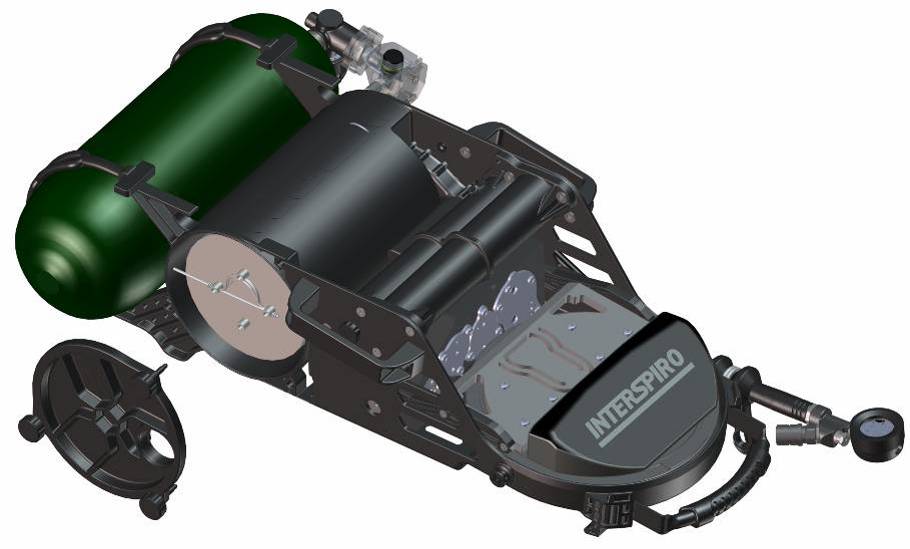
The canister housing with the canister lid removed.