Dosage warning
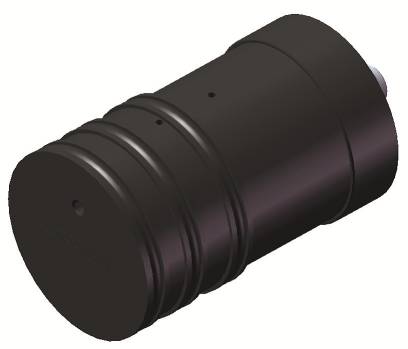
The dosage warning monitors the dosage pressure in the dosage regulator and the intermediate pressure in the pressure regulator and thereby indirectly the high pressure supply. Leakage in the breathing circuit will also lead to the dosage warning being activated.
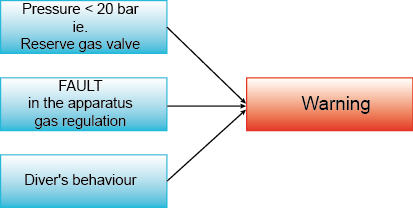
Causes of warning.
Warning for pressure below 20 bar
Following a warning for the gas supply pressure being below about 20 bar the diver will be made aware of this in the form of increased breathing resistance during inhalation, known as active warning. The warning indicator located on the breathing circuit's inhalation side then throttles the gas circulation.
In the event of a warning, the diver acknowledges this by pulling the reserve gas valve and pressing the by-pass arm backwards whereupon the by-pass valve opens and fresh gas fills the breathing circuit and the warning indicator moves back to the open position. The dive must then be immediately aborted. Warning for low gas supply pressure will (provided that the warning has been acknowledged) not re-occur until the gas supply is exhausted.
Warning for fault in gas regulation
In the event of a fault in the IS-MIX gas regulation, the warning will return after about 1 minute. The diver is thereby reminded that he must perform another by-pass as the fault has not been corrected.
In addition to the warning being temporarily disabled following a by-pass, this gives a manual supply of gas to the breathing circuit, which ensures that the gas in the breathing circuit is life sustaining (following a failure in the gas regulation). The dive must then be immediately aborted.
Warning caused by the diver's behaviour
The dosage warning is designed to be extra sensitive and can sometimes give warnings even though the IS-MIX is operating properly.
This may occur when the diver is “breathing low”, takes several breaths of less than about 1 litre, which the dosage warning interprets as a low dosage. This warning can be breathed away by increasing the breathing volume, or by performing a by-pass. The pressure gauge should always be checked following a warning. A “low-dosage” provides no benefits as the IS-MIX still has a very long action time.
Another example is if the diver makes a quick descent/ascent, possibly combined with low breathing, which produces a rapid decrease in volume in the breathing circuit as a result. This process has the same characteristics as a leak in the breathing circuit and may result in a warning being given. The warning can also be given if the diver holds his breath for more than about 60 seconds.