Design
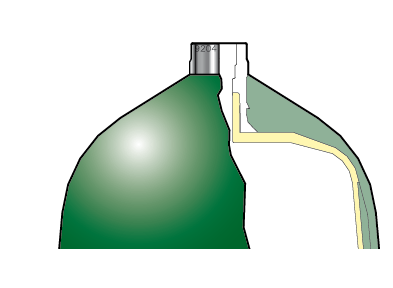
1 Epoxy lacquer |
3 Liner |
2 Carbon and glass fibre-reinforced epoxy |
Gas cylinder construction.
The gas cylinder is made of composite materials. The composite consists of a surface layer of epoxy lacquer, a layer of carbon and fibreglass reinforced epoxy and a resilient gas-tight liner of thermoplastic on the inside. The fibres are wound using a proven geometric pattern around the liner.
After manufacture only the fibre reinforcement and non-magnetic steel connections are visible.
The advantage of the composite material, when compared to gas cylinders of metal, is the drop in weight and that they are totally non-magnetic. This simplifies handling, for example when donning the diving equipment.
The liner serves as a gas-tight inner layer. The fibre composite itself is not gas-tight. The epoxy protects the fibres from the external environment and retains the fibres in the most efficient load bearing pattern. The connections in metal are fixation points during manufacture. The connection at the neck is designed for the cylinder valve.